
Some weirdo who calls themself frillSquid made the suggestion of cycles for Bibliotheca's January/February theme, so now I have to follow through. It's far too late to go with New Year's or Groundhog Day as a central point of the post, so I'm going with something that I think about frequently: trends.
I used to think lolita was immune to mainstream trends. After all, lolita is an alternative fashion, so our style either ignores or contradicts mainstream (and fast) fashion. We still have defined release seasons, we keep or sell our clothes indefinitely, we keep to the same color palettes, and we've barely existed long enough for fifteen-year trend cycling to even be possible.
However, having observed lolita over the decade-plus I've been wearing it, it's undeniable that there have been distinct trends, both isolated within the fashion and spreading outside it, as well as long-term changes that transcend trend status.
This post isn't an encyclopedia of lolita trends, just a casual exploration of how lolita interacts with changing fashions, both within the community and in the broader fashion world. So no, I don't discuss galaxy prints or striped socks with everything or mermaid wigs-- it's about the trends of trends as a whole, not the granular trends themselves.
Trends within lolita
Lolita has its own trends, often related to certain materials, themes, or unique silhouettes.
For example, velvet metallic screenprints were popular in the early 2000s, but nearly disappeared due to price-- Vierge Vampur keeps making velvet screenprints, but that brand works with incredibly small quantities. In the same vein, the popularity of dot-patterned tulle in the mid-late 2000s declined with the rise of embroidered tulle lace. As for silhouettes, the mini-salopette seems to have come and gone in the early 2010s. Likewise, poodles used to be immensely popular as a theme, but they have gone nearly extinct in lolita.
 |
| This 2010 GLB image shows off the gold and velveteen Twinkle Ornament JSK |
The biggest category of trends within lolita are those that incorporate other fashions. These are by nature short-lived as those fashions come in and out of style. Gyaru move much quicker with style than us sluggish lolitas do, so the himegyaru boom focused around 2010 died down within only a couple years, taking most hime lolita releases with it.
 |
| The extremely gyaru-leaning Heart Leopard by Meta |
Deco-lolita, that trend of going full decora with plentiful accessories piled onto a lolita coordinate, had some longevity through the 2010s. Today's most OTT (over the top) Angelic Pretty releases can't hope to match deco-lolita's eye-searing heights.
Most recently, brands including DreamV, Angelic Pretty, and Atelier Pierrot have mixed jirai-kei and lolita. I don't anticipate this trend having much longevity; jirai is an extremely youth- and social media-oriented style compared to lolita, so I can see them moving on without us. To be less charitable, jirai appeals to a very dedicated and extremely online demographic, but it takes offline community to give a trend enough momentum to become a lasting style.
 |
| Dear My Love Emily, DreamV's jirai lolita line |
Most of these trends are focused within sweet lolita. Trends within classic, like painting prints or long underskirts, generally join the canon of accepted themes in the style rather than fading away. Painting dresses are still released, after all, and the long underskirts of OTT classic have been subsumed into the wedding-inspired styles common with higher-end brands. Meanwhile, gothic lolita adopts certain trendy elements-- take halo crowns-- but changes a lot less over time. There's a reason that Atelier Pierrot and Marble release the same dresses for literal decades: gothic lolitas know exactly what they like.
Trends outside lolita
Although most lolita clothing trends operate within lolita and the J-fashion ecosystem, lolita makeup, hairstyles, and footwear seem to align more frequently with greater cultural trends.
| A street snap of a lolita in FRUITS #33, from 2000 |
The footwear part is pretty easy to attribute to the blogger's great enemy, material conditions. Shoes are expensive, they wear out, and lolita shoes have been overwhelmingly made of synthetic materials (read: plastic) until fairly recently. Plastic shoes can and will disintegrate. I wore elegant heels with lolita in 2015 because they were easy to buy at the time, just like chunky platforms were in 2000. Shoes are an investment, and investments are shaped by the market.
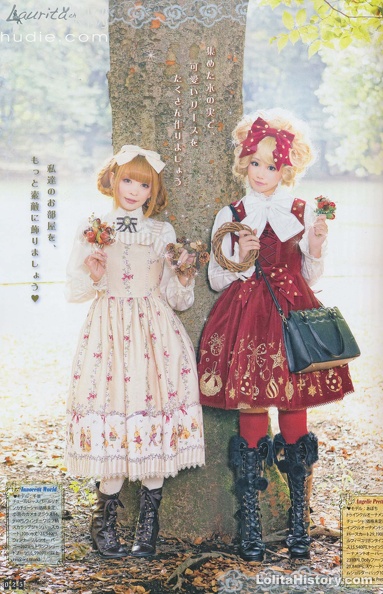
Makeup and hair speaks to another simple fact-- lolitas are people outside of lolita. In fact, most lolitas I know wear lolita twice a week or less. We may take up an entirely different wardrobe, but our faces and natural hair remain the same. Some lolitas do totally different makeup, put on wigs, or wear color contacts in lolita; by and by, lolita is not someone's primary presentation. Makeup and hair are nice! It's just that they're not that important to a coordinate. Makeup is also harder to import than clothing. Plus, many Japanese products are flat-out unusable for people with darker complexions or curlier hair textures.
This is where international lolitas bring in our own culture and trends. I have changed my makeup style throughout my lolita life, beginning with the thick layer of cosplay makeup I plastered on as a teen, then the heavy contouring and aggressive eyebrows of my early 20s, and now focusing on the eyeliner and blush. Other lolitas have worked in the Tumblr trend of fawn makeup, decora-inspired face stickers, and the viral glassy Pat McGrath porcelain doll makeup in turn. Black lolitas with coily hair have used hairstyles like afro puffs to incredible effect. In a fashion almost-exclusively about clothes, makeup and hair are basically a free-for-all.
Larger shifts
Along with these smaller trends, there have been significant shifts in the fashion that completely restructure the lolita landscape. Unlike the above trends, which have slipped in and out of relevance, these massive changes just aren't going away.
Custom color printing is the earliest and most prominent game-changer in shaping lolita as we know it today, to the extent that many lolitas refer to all main piece releases as 'prints'. Although Jane Marple was printing their own fabrics well before lolita really took off, original prints were still notable enough in the early 2000s to be a selling point for certain releases. 2008 began the border print boom, and from there prints exploded. Custom fabric printers like Spoonflower made it so that, by the early 2010s, anyone could make their own print, even the smallest indie brand or home sewist. Today, original prints are only a matter of design choice and cost, not of technical limitation.
 |
| Moitie's Original Print JSK from 2004 |
Polyester is another technology-induced change. Like printing, polyester has existed throughout lolita's lifetime. However, it majorly sucked. Cotton was the predominant fiber used in early lolita, not because of active choice, but because of availability. Technology marches on, though, and the low cost of polyester created from byproducts of petroleum processing made it worth experimenting with. Today's higher-quality polyester fabrics make it an actual fiber to consider for lolita-- although pricier cotton is a sign of quality and old school authenticity, polyester is perfectly acceptable in most styles. Unfortunately, the downsides of polyester (namely, the lack of breathability and resulting grossness) are unavoidable.
Silhouette variation has also increased. Tea-length styles, mermaid skirts, and miniskirts are littered throughout lolita history-- it's only in recent years that the oversize bridal silhouettes and mega-poofy miniskirts have cemented their way into the lolita canon, largely through Chinese brands like Classical Puppets. Some brands (Innocent World) no longer bother with the formerly-standard knee length silhouette, presumably because they hate me personally and long for my downfall. There's no longer a feeling that knee length is the one-and-only default-- there are enough shapes for everyone.
Speaking of shapes and inclusivity, sizing is another area which has greatly and irreversibly improved. Major brands h. Naoto, Metamorphose, and Atelier Pierrot have released actual plus sizes, a far cry from the 68cm waist one-size-fits-all skirts that haunted my early years in the fashion. This is thanks to the international community-- English-speaking lolitas have convinced the Japanese brands, while some Chinese brands that always offered multiple sizes have expanded their range. It's not perfect by any means, but there's finally some room to breathe.
The biggest general shift is the worldwide spread of lolita: it's not really a Harajuku-centered style anymore. There are far more Chinese lolitas than there are Japanese lolitas, and the Chinese domestic lolita market eclipses the size of all the other international brands. What really cemented this change in my mind was the opening of a physical Hoshibako Works store in Tokyo. The international borders that defined brand status have become largely irrelevant except for shipping purposes: Innovation in the style can come from anywhere. Harajuku will always be the cultural birthplace of the fashion, but the current home of lolita is wherever the fashion is worn and loved.
Continuity
One incredible thing persists in this fashion: nothing truly dies. With careful preservation and the secondhand market, clothes can be worn, recognized, cherished, and sought after nearly thirty years after their release (like that one skirt I sold). The more widespread trend might end, but we live our ideals regardless.
In my area's greater community network, we have lolitas committed to styles so granular that they would have long ago died out in other fashions. Any given event will have someone in 2002 Metamorphose Crown Print, another in 2017-style princessy classic, a person wearing 2012's finest OTT sweet, and a fourth in something released this very year. We may share the fashion, but each person brings their own perspective, colored by memory.
Currently, the style of lolita popular around 2004 is trendy. This feels like the first real cycling I've felt in this fashion, and even then, it's fun seeing the differences that reinterpretation brings. At the same time, radical new releases like Metamorphose's Cyber Neon Girl show that the fashion is still ripe for change and innovation. The most exciting part: I have no idea what's next! The future can only be explored by living through it.
Lolita, like all slow fashion, allows the wearer to love the past without living in it, to choose from trends without being trapped in them, and to enjoy fashion without being a victim. We don't have to follow anything at all. So just sit back, watch the fireworks, and keep choosing only the trends that make you happy.
No comments:
Post a Comment